by Michael Gill
This article can be accessed / cited here: https://doi.org/10.5281/zenodo.19519637 and is available for download as a PDF at the end of this article.
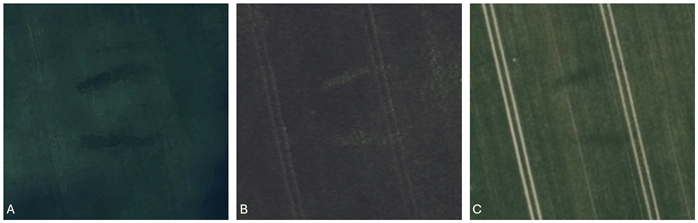
Neolithic long barrows are amongst the earliest monuments in Britain and are relatively rare compared to the almost ubiquitous Bronze Age round barrow. Despite their rarity, the volume and frequency of new releases of aerial and satellite imagery on publicly available websites means that new discoveries of long barrows are sometimes made. This is the case with an example near East Meon, in Hampshire, where the cropmarks of a long barrow have recently been identified by the author. This article will describe the characteristics of the long barrow and its landscape position.
The location of the long barrow is shown in Figure 1. It is positioned on a gentle west facing slope, adjacent to the springs that represent the source of the River Meon. It is about 1.3 km south of the village of East Meon.
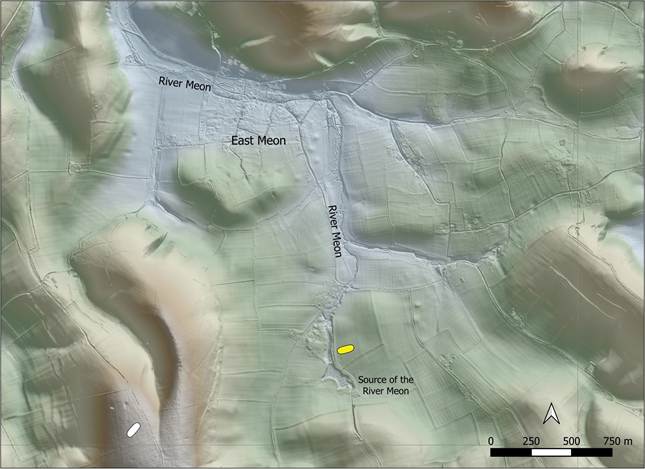
Figure 1: Map showing the location of the recently discovered long barrow, shown with a yellow symbol, near the source of the River Meon. The location of the nearby Salt Hill long barrow is shown with a white symbol. Contains public sector information licensed under the Open Government Licence v3.0.
Continue reading “A Recently Discovered Long Barrow near East Meon, Hampshire”